

Are Stocks and Shares The Same Thing?
“Stocks” and “shares” Are you confused as an investor about how to cope or handle this? Well, in the realm of investment both the notations are used interchangeably and can create confusion for individuals, especially for beginners. You may at times hear someone saying, “I purchased some stocks today,” while another might say, “I bought around 30 shares of Apple.” So, what’s the real and basic difference? Do you have any ideas? Are stocks and shares the same thing, or is there a subtle distinction between the two we should be aware of?
In this article, let’s break it down and clarify the concepts in a comprehensive manner to help you become a more informed investor. So, let’s now learn and understand the basic aspect and concept of stocks and shares.
Understanding the terminologies
Before delving into terminology, it’s highly necessary and crucial from an investor’s point of view to understand the fundamental concept behind stocks and shares. When you invest in a publicly listed company, you’re basically purchasing a part of that company or the organization. This ownership stake is what enables you to participate and share in the company’s financial prosperity or absence thereof. You might receive dividends, and have voting rights in certain situations as well, and possibly profit from price appreciation over the long term.
Now let’s understand the concepts in an elaborate manner.
What is Stock?
When we say “stock” the notation explains a category of financial instrument that usually indicates or denotes ownership of one or more firms. When a person mentions they are “investing in stocks,” they often imply or mean to explain that they hold equity in listed companies.
Stocks are a relatively broader term utilized to define the equity interest in some number of businesses or ventures. As an illustration, suppose you have stock in companies Microsoft, Tesla, and Coca-Cola, you have three different stocks. Each stock is a stake in each company individually or separately.

Types of stocks
- Growth stocks: These are stocks of companies expected to grow quicker than average
- Value stocks: These are usually stocks of companies that appear underpriced
- Blue chip stocks: Stocks usually categorized of large, well-established companies
- Small-cap stocks: Smaller companies with room to grow
- Dividend stocks: Companies that regularly share profits with investors
What are Shares?
Now let’s discuss shares. A share is a unique unit of ownership in a firm. Suppose, if you have fifty shares of Nestle, you own fifty units of Nestle’s stock.
Therefore, if “stock” is the category, “shares” are the units within that category. Consider it this way: stock is the cake, and shares are the slices. The number of shares you have determines how much stake you have in a company.
Types of Shares
Common Stock
Common stock is the most popular type of equity and what most individuals purchase when they plan to invest via a brokerage:
Voting rights: This share type usually caters to one vote per share to elect board members and make major company decisions.
Dividends: Investors can get dividends, but payouts are not guaranteed and can vary with the market.
Risk & reward: Greater risk than preferred shares, but more potential for long-term price appreciation.
Bankruptcy priority: Common shareholders are the last to be paid in the case of liquidation—following creditors as well as preferred shareholders.
Preferred Stock
Preferred stock combines elements of both debt and equity, with a more stable and income-driven investment:
Fixed Dividends: Pays regular dividends in fixed amounts, given priority over common shareholders.
Less Volatility: Prices are generally less volatile than common stock.
No Voting Rights: Generally, preferred shareholders do not have any voting rights within the company.
Priority in Bankruptcy: During liquidation, preferred shareholders get paid first ahead of common shareholders.
Bond-Like Behaviour: Behaves like fixed-income securities, thus appealing to risk-averse investors.
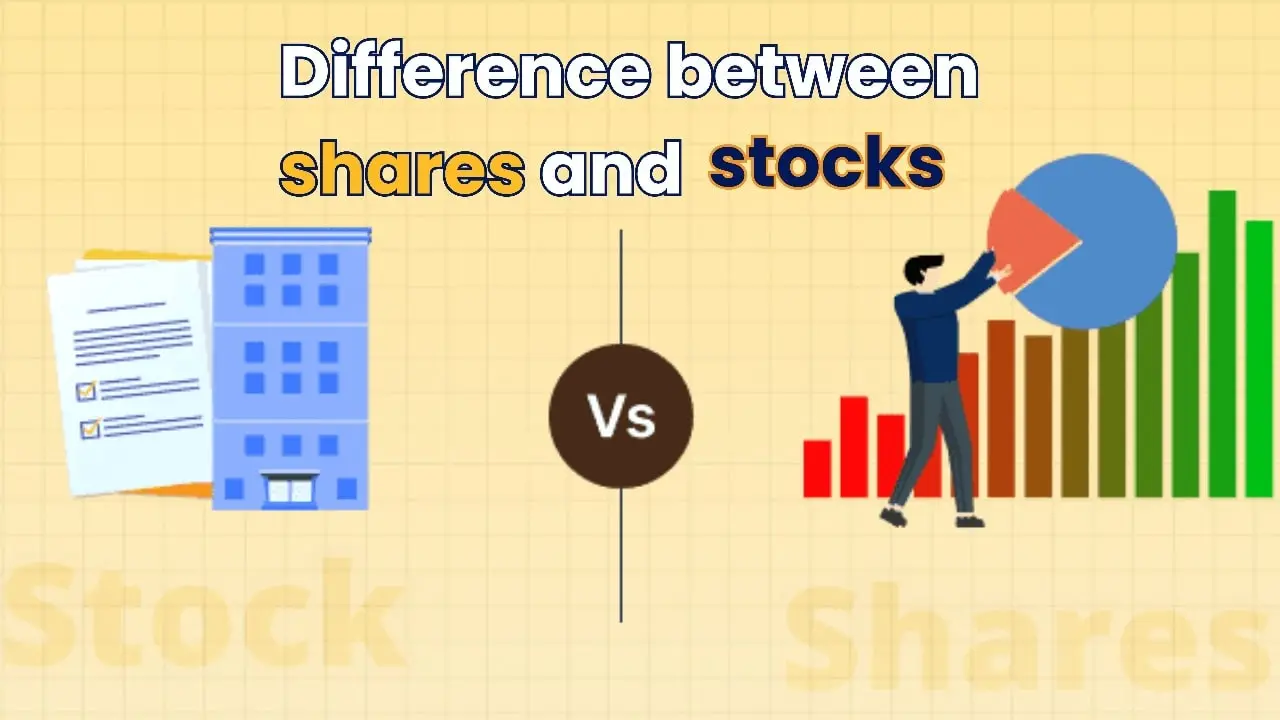
Difference between shares and stocks
From the above-mentioned discussions hope you gained an idea about the concept of stocks and shares. So, let’s now check out the differences between shares and stocks.
People often use the words stocks and shares like they mean the same thing, but they have small differences when it comes to money and law. If you know how they’re different, you can better understand investing.
- Definition – Stocks mean you own parts or segments of one or more companies. When someone says they have stocks, it means they actually own pieces of different businesses. On the other hand, Shares are exact units of ownership in one company. For instance, if you have around thirty shares of Nestle, you own a specific chunk of the respected company.
- Scope – Stocks is indeed a broad word that comprehensively narrates all the parts of companies an investor owns across different businesses or companies. However, Shares are a more exact form and they explain to you how many units you own in just a single venture or company.
- Usage – In the United States, people often use the word “stock” in casual conversations. Whereas, In the United Kingdom, people use the notation “share” more, and you’ll see it in legal papers and official stuff. In India both the terms stock and share are used and are quite popular among investors.
- Plurality – You have the authority to own stocks in more than one company. As an investor, you hold a specific number of shares for each stock you possess.
- Context – Individuals or investors often discuss stocks when discussing a portfolio or the stock market.
How are shares and stocks traded?
Stocks and shares are sold on stock exchanges such as the BSE or NSE. They are usually purchased and also sold by investors with the aid or assistance of brokers via market or limit orders.
Prices of shares or stocks may vary in accordance with supply, demand, and market conditions. Trades occur electronically to provide speed and to keep transparency of the entire procedure. The process is regulated to ensure equity and protect investors by definite regulatory agencies. Investment and economic growth are stimulated by this process.

What are the risks and benefits involved while investing in the stock market?
Stock market investment provides numerous merits such as probable high returns, dividend payment, as well as proper growth of your invested wealth.
Stock market investment has risks as well and you need to be very like market fluctuations, economic crises, and also businesses or ventures may develop issues. The prices of the stocks may highly fluctuate and result in loss. So, what you need to do is develop proper research based, diversified portfolio that will make the balance of risks and returns; hence, stock market investment is both demanding and profitable.
So, what are stocks and shares in simple terms? Do you think are stocks and shares the same thing? To answer this question you need to say, yes. Both the terms are often used interchangeably—and in most cases, that’s perfectly fine. Understanding this nuance can perfectly assist you to explain or communicate more clearly and make more informed financial decisions. You might be a casual investor or planning to develop a diversified portfolio, knowing and understanding the basic differences between stocks and shares is a solid step toward becoming a savvy investor. To learn more about stocks and shares keep reading Minty Cents.
Start Investing with *Upstox*
Open your FREE Demat & Trading account in just a few minutes and start your investing journey today!
👉 Click here to Sign Up on Upstox: https://upstox.onelink.me/0H1s/2SC8Z5
Affiliate Notice: This is an affiliate link. If you sign up through it, Minty Cents may earn a small commission at no extra cost to you.
Trade Smarter with *Angel One*
Join one of India’s leading brokers and get access to powerful tools, expert research, and easy investing options.
👉 Click here to Sign Up on Angel One: https://angel-one.onelink.me/Wjgr/sh6pgfwa
Affiliate Notice: This is an affiliate link. If you sign up through it, Minty Cents may earn a small commission at no extra cost to you.
Disclaimer – This blog is for informational purposes only. Before conducting any investment, it is advisable to carry out comprehensive research.
People Also Ask About Are Stocks and Shares The Same Thing
What is the difference between stock and shares?
Stock usually denotes general ownership in one or more companies. On the other hand, shares are specific or particular units of ownership in a single venture.
Is buying stocks and shares the same thing?
It may be purchasing stocks or shares both mean acquiring ownership in a company. However, “shares” refers to the exact number of units you purchase.
Is the stock market the same as shares?
The stock market is usually the platform where shares are bought and sold. Whereas, shares are single units of ownership being traded.
1 stock equals how many shares?
“1 stock” isn’t a perfect measurement. You own stock in a company, which usually means any number of shares.
Difference between stock and share market
People often use the terms stock market and share market. Both terms point to places where you can buy and sell parts of companies or equities.
100 shares of stock are called
A “round lot” is what people call 100 shares of stock.
What are shares in the stock market?
In the stock market, shares stand for small pieces of ownership in a company. When you own shares, you get certain rights. These include getting a part of the company’s profits and having a say in big company decisions.


